The Memorabilia Trap: When Rarity Replaces Meaning
Film memorabilia gains meaning through its connection to a film, a viewer, and a moment—not scarcity alone. Learn how to read a keepsake beyond its label.
A numbered lobby card can be hard to find and still mean very little to the person who owns it. Film memorabilia becomes meaningful through its relationship to a movie, a viewer, and a particular moment; rarity may add interest, but it cannot supply those connections by itself.
That distinction matters whether you have a ticket stub in a drawer, a prop replica on a shelf, or a signed poster bought at a convention. Instead of asking only how scarce an object is, ask what it remembers, what it tells you, and whose story its value serves.
What does rarity actually tell you?
Rarity describes availability. An object may be scarce because few were made, because most were discarded, or because surviving examples are difficult to verify. Those facts can make an item collectible, but they do not automatically make it emotionally resonant or culturally important.
A limited-edition enamel pin, for instance, may be rare because it was produced for a small event. A worn ticket stub from an ordinary screening may be common in principle but irreplaceable to the person who kept it. Scarcity concerns how many comparable objects exist; meaning concerns what this particular object can carry.
The two can overlap. A scarce item tied to a film’s original release may help explain how the movie was promoted or received. But that connection needs to be established through the object’s details and context, not inferred from a collector’s label or a high asking price.
How does a keepsake acquire meaning?
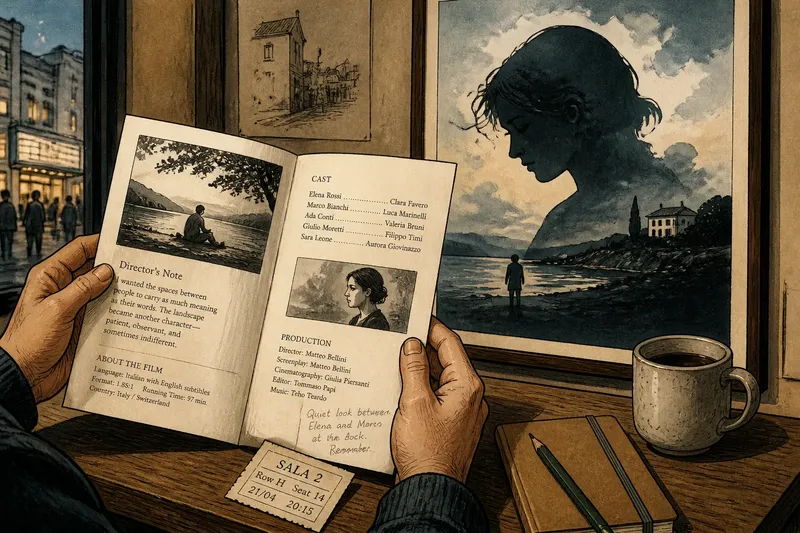
Meaning often begins with use. A program folded in a coat pocket, a concession cup saved from a family outing, or a postcard picked up after a repertory screening has a history of handling and keeping. Its marks can suggest how it traveled, though they rarely tell the whole story on their own.
Personal memory adds another layer. The ticket may bring back who sat beside you, what you noticed in the theater, or how a film felt before you had words for it. Another viewer could hold an identical ticket without sharing any of those associations. The physical object is similar; the remembered event is not.
Cultural meaning works differently. A poster, press kit, or promotional item can reveal how a film was presented to audiences: which images were emphasized, what tone the campaign used, and what kinds of viewers it appeared to address. That interpretation depends on context. A dramatic tagline might describe a distributor’s pitch more accurately than it describes the film itself.
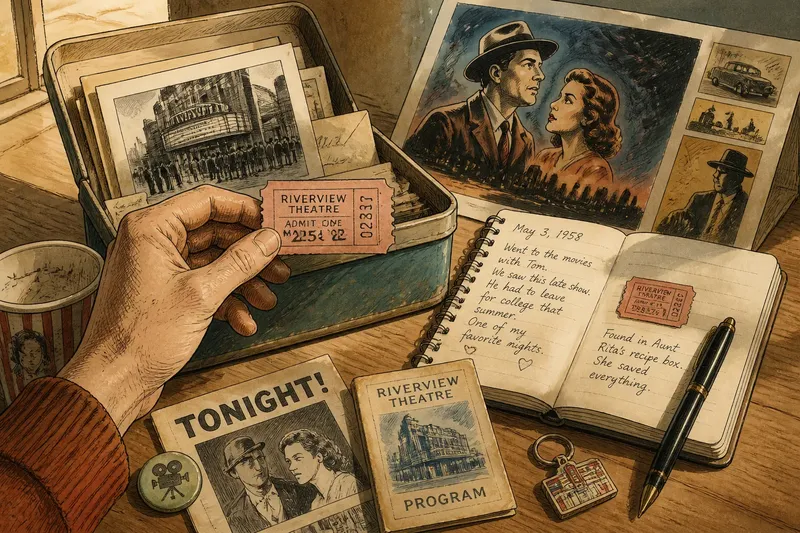
Consider a clearly invented situation: say you find an old ticket from a neighborhood theater in a relative’s recipe box. You ask which movie they saw and learn that the outing was a rare evening with a sibling who later moved away. The ticket’s paper may be ordinary, but recording the story alongside it gives the object a specific personal meaning that scarcity could never provide.
Which questions help you read a film keepsake?
Useful questions make room for both affection and skepticism. You do not have to choose between enjoying an object and asking what supports its claims.
- What is the object, specifically? Distinguish an original theater handout from a later reproduction, a production-used prop from a licensed replica, and a release poster from a later reissue design.
- Where did it come from? A known owner, venue, or collection history may help establish context. A vague story is not the same as documented provenance, though a family memory can still matter personally.
- What evidence supports its connection to the film? Look for printed credits, distributor markings, production labels, or reliable accompanying documentation. A familiar image alone does not prove an object’s origin.
- What does its condition tell you? Fading, folds, tape, and handwriting may reflect handling or storage. They can be part of the object’s story, but wear alone does not establish age or authenticity.
- What does it mean to you apart from its price? If the market value vanished from the conversation, would you still want to keep, display, or learn about it?
The answers need not all be certain. “I know where this came from, but not who owned it before” is more useful than turning a gap in the record into a confident story. Uncertainty can be part of an honest interpretation.
What changes when collectors and institutions value an object?
Collectors often focus on condition, authenticity, edition, and demand. These are practical ways to compare objects in a market, and a seller may use terms such as “rare” to signal that an item is not easy to find. That language describes a collecting claim, not a complete account of the object’s significance.
Archives and museums ask a broader set of questions. An item may matter because it documents a local screening, a distribution practice, or a film culture that left few other records. A modest flyer from a neighborhood cinema might offer useful evidence about a community’s moviegoing life even if collectors show little interest in it.
Personal and institutional value can also diverge. Someone may treasure a mass-produced keychain because it recalls a first date, while an archive may be more interested in an unremarkable press sheet that shows how a film was marketed. Neither judgment cancels the other; they answer different questions.
Labels should make those differences clear. “Original,” “limited,” and “screen-used” each imply a claim that deserves context. If you are buying or donating an item, ask what the description is based on and keep any relevant paperwork or story with it. Where authenticity or provenance has financial or archival consequences, seek a qualified specialist rather than relying on appearance alone.
How can you preserve the story without overstating it?
Write down what you know while the details are fresh: who gave you the object, where it was found, what occasion it recalls, and which parts are uncertain. A small note kept with a ticket or stored with a digital photograph can preserve context that the object itself cannot show.
Use careful wording. “My aunt said she collected this at the theater” preserves a family account; “distributed at the original premiere” makes a much stronger claim. Separating observation from memory lets a future reader understand both the evidence and its limits.
Storage can protect the object while respecting its materials. A clean, dry place away from direct sunlight is a sensible starting point for many paper keepsakes, and archival sleeves or folders can reduce handling. Materials vary, so follow the item maker’s care guidance or ask a conservator when an object is fragile or especially valuable.
Displaying a keepsake is another kind of interpretation. Putting a ticket beside a photograph of the theater connects it to a place; pairing a promotional postcard with a note about the film’s campaign emphasizes its public life. The arrangement does not prove a hidden history, but it can make your reason for keeping the object legible.
Does a rare object have to be valuable?
Can a common film item still be meaningful?
Yes. A widely distributed souvenir can hold a specific memory of a person, place, or screening. Its personal importance does not depend on how many comparable copies survive.
Does a high price prove that an item is rare?
No. An asking price reflects a seller’s request, not an independent account of scarcity or authenticity. Compare the item’s documentation and description rather than treating price as proof.
What if I cannot verify where my keepsake came from?
Describe what you can observe and identify what you have heard or been told. An uncertain origin limits some historical claims, but it does not erase a genuine personal association.
Should I keep an object I do not collect?
Decide whether it matters to you, whether you can care for it, and whether someone else or a local archive might make better use of it. Let the decision follow the object’s story and your circumstances, not scarcity language alone.
What is worth keeping in mind?
Rarity can prompt a closer look, but it is not a substitute for one. A film keepsake becomes easier to understand when you separate its material facts, its documented history, and the memories people attach to it. Those strands may support one another, or they may remain distinct.
If you are deciding whether an object belongs in your collection, begin with the question you would still care about if nobody called it rare: what does this item help me remember or understand? That answer is a sturdier reason to keep it than scarcity alone.