From Nickelodeon to Picture Palace: How Cinema Spaces Changed Moviegoing
See how the nickelodeon-to-picture-palace shift changed moviegoing, from short-film storefront programs to purpose-built auditoriums and grand-scale screen events.
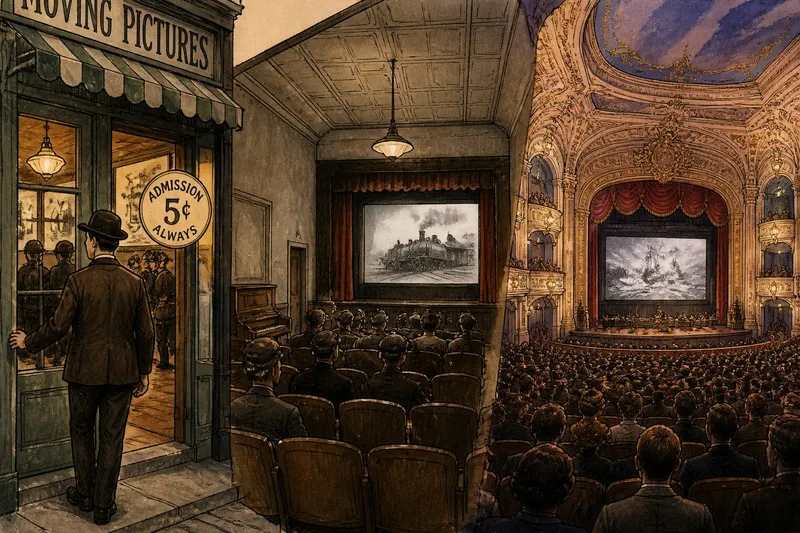
The nickelodeon-to-picture-palace shift changed what a trip to the movies asked of its audience: a quick stop for short films could become a planned public occasion. The transformation was uneven, not a neat march from one building type to another, but the spaces reveal how exhibition shaped habits of watching.
What did a nickelodeon offer?
In the early years of cinema, nickelodeons commonly occupied modest storefronts or other converted rooms. The name became associated with small admission prices, though venues and programs varied. A customer might enter from a commercial street, watch a changing program of short films, then continue with the day.
The format suited brief, repeatable visits. Programs could combine films rather than center on a single feature-length attraction, and the room’s straightforward arrangement made the screen the immediate draw. Moviegoing could sit among other everyday amusements instead of requiring the planning associated with a special night out.
Imagine a shop worker finishing an errand near a storefront nickelodeon and choosing to go in for a short program. The starting point is an ordinary outing, the action is an unplanned visit, and the expected result is an accessible entertainment stop rather than an evening organized around one film. That distinction describes a possible experience, not every audience member’s routine.
How did dedicated theaters change the viewing room?
As exhibitors built or adapted venues specifically for film programs, they could organize the auditorium around a fixed screen, rows of seats, and a shared direction of attention. This practical arrangement made a clear difference: audiences were gathered to watch together, rather than encountering moving pictures as one attraction within a more flexible room.
Purpose-built theaters also gave exhibition a more stable setting. A program could be presented in a room with a defined entrance, auditorium, and screening schedule. These features encouraged a more deliberate appointment with the screen, though they did not make every visit formal or erase smaller venues.
Say a neighborhood operator is choosing between using a multipurpose room and arranging a dedicated auditorium. If the room has fixed forward-facing seating and a screen placed for the whole audience, viewers can settle into a common viewing direction; if it remains a flexible hall, the operator can accommodate different events but has less control over the screening environment. The tradeoff is between a room tailored to film and a space that serves several purposes.
Why did picture palaces make scale part of the show?
Picture palaces, especially prominent in the United States during the late 1910s and 1920s, made theatrical architecture an attraction in its own right. Their designs could borrow from varied architectural styles and include elaborate auditoriums, balconies, decorative schemes, and stage facilities. The exact features differed from theater to theater; the shared idea was to present moviegoing as an event with a setting larger than the screen alone.
That scale could affect the audience’s sense of occasion without requiring a particular ritual. A richly appointed auditorium might make a screening feel ceremonial, while a large seating area gathered strangers into one public audience. The building’s ambition also reflected exhibition as entertainment: the venue competed for attention through the experience it offered around the film.
These theaters were not simply larger versions of nickelodeons. They belonged to different exhibition conditions, including changing film programs, growing demand for longer features, and operators’ efforts to make attendance attractive. The progression was not universal: storefront venues, dedicated theaters, and grand houses could coexist, and local circumstances shaped what audiences encountered.
What do cinema spaces tell us about moviegoing?
Why were nickelodeon programs often made up of short films?
Early programs commonly brought together short subjects, which suited a format built around changing attractions rather than one feature-length presentation. Individual venues and programs varied, so the format should not be treated as identical everywhere.
What made a theater purpose-built for film?
Its auditorium was arranged to present a screen program to a seated audience, with viewing direction and sightlines central to the room’s layout. A dedicated venue could still host other entertainment, but film exhibition shaped its basic organization.
Were picture palaces found in every town?
No single kind of theater defined every community. Grand houses were especially visible in larger urban entertainment districts, while smaller or multipurpose venues remained part of moviegoing elsewhere.
Did picture palaces replace nickelodeons?
Not in one clean, universal transition. Exhibition spaces changed at different times and in different places, and audiences could encounter distinct kinds of venues within the same broader period.
How can you read the difference between these venues?
Compare what the building made possible rather than treating its appearance as a simple measure of progress. A storefront location could put short programs near ordinary street activity; a fixed auditorium could concentrate attention; a palace-style theater could make spectacle part of the event. Each offered a different relationship between the film, the room, and the audience.
- Observe the entrance: If it opens directly onto a commercial street, consider how easy it might be to make an unplanned visit; if access is more formal or prominent, consider how the venue signals a planned event.
- Observe the seating: If seats face a fixed screen in orderly rows, infer that collective viewing is central; if the room is flexible, allow for multiple uses rather than assuming a film-only design.
- Observe the screen’s placement: If it anchors one end of the auditorium, the room organizes attention forward; if other stage or performance features share the focus, consider a mixed program.
- Observe the decorative scale: If ornament extends through the auditorium, treat the setting as part of the attraction; if decoration is restrained, avoid assuming the visit was less important to its audience.
- Observe the venue’s size and facilities: If the building includes balconies or substantial stage space, consider how it could support a large, varied entertainment program; if those features are absent, focus on the screening arrangement rather than guessing at capacity.
- Observe the program evidence: If surviving listings name several short subjects, read the visit as a varied program; if they identify a feature, note that the screening was organized around a longer film without assuming every show followed the same pattern.
The nickelodeon-to-picture-palace story is most useful when it stays local and specific. A storefront, a fixed auditorium, and an ornate city theater were not merely stages in a single evolution; each gave audiences distinct ways to encounter films. When looking at a historic cinema, the seating plan and surviving program can be as revealing as its facade.